


A comfortable bedroom environment plays a crucial role in sleep quality, relaxation, and overall well-being. While air conditioning systems can help regulate temperature, many homeowners prefer bedroom fans as a cost-effective, energy-efficient, and quieter alternative. Today’s smart home technology has transformed traditional fans into intelligent devices capable of automatic operation, voice control, remote management, and personalized climate settings.
- Why Bedroom Fan Noise Matters
- The Rise of Smart Bedroom Fans
- Key Features to Look for in a Quiet Smart Bedroom Fan
- Best Types of Quiet Fans for Smart Bedrooms
- Smart Automation for Better Sleep
- Energy Efficiency Benefits
- Real-World Example
- Choosing the Right Fan for Your Bedroom
- Maintenance Tips for Quiet Operation
- Conclusion
For smart homeowners, choosing a quiet bedroom fan is no longer just about airflow. Modern smart fans can integrate with home automation systems, respond to temperature changes, and operate silently enough to avoid disturbing sleep.
In this guide, we’ll explore the benefits of smart bedroom fans, the key features to look for, and the best types of quiet fans that combine comfort, convenience, and intelligent control.
Why Bedroom Fan Noise Matters
Many people underestimate the impact that noise has on sleep quality.
While some individuals enjoy gentle background sound, excessive fan noise can interfere with deep sleep cycles and reduce overall sleep efficiency. A noisy fan may cause frequent awakenings, difficulty falling asleep, or general discomfort during the night.
The Ideal Noise Level for Bedrooms
Most sleep experts recommend maintaining bedroom noise levels below 30 decibels whenever possible.
Modern smart fans often operate between:
- 20–25 dB on low settings
- 25–35 dB on medium settings
- 35–45 dB on high settings
For comparison, a quiet whisper is typically around 30 dB.
The quieter the fan, the easier it becomes to maintain a peaceful sleeping environment.
The Rise of Smart Bedroom Fans
Smart fans have become increasingly popular as homeowners seek greater control over their indoor climate.
Unlike conventional fans, smart models can connect to:
- Wi-Fi networks
- Mobile apps
- Voice assistants
- Smart home hubs
- Temperature sensors
This connectivity enables automated operation based on user preferences and environmental conditions.
Benefits of Smart Fan Control
Smart controls provide several advantages over manual operation:
- Remote management
- Automated schedules
- Voice commands
- Energy savings
- Temperature-based adjustments
- Sleep-friendly routines
These features make everyday comfort effortless.
Key Features to Look for in a Quiet Smart Bedroom Fan
DC Motor Technology
One of the most important features is the motor type.
Fans equipped with DC motors generally offer:
- Lower noise levels
- Improved energy efficiency
- More speed settings
- Smoother operation
Compared to traditional AC motors, DC motors can reduce both energy consumption and unwanted noise.
Multiple Speed Levels
A wider range of speed settings allows users to fine-tune airflow according to personal comfort preferences.
Many premium smart fans offer:
- 8 to 12 speed levels
- Sleep mode operation
- Adaptive airflow control
This flexibility helps maintain comfort without creating excessive noise.
Smart App Integration
Mobile applications provide complete control over fan settings from anywhere.
Typical app features include:
- Speed adjustments
- Scheduling
- Timer functions
- Oscillation control
- Energy monitoring
This level of convenience is especially useful for busy households.
Voice Assistant Compatibility
Many smart fans integrate with popular voice assistants.
Examples of useful commands include:
- “Turn on the bedroom fan.”
- “Set the fan to low speed.”
- “Start sleep mode.”
- “Turn off the fan in one hour.”
Voice control eliminates the need to reach for remotes or smartphones during the night.
Best Types of Quiet Fans for Smart Bedrooms
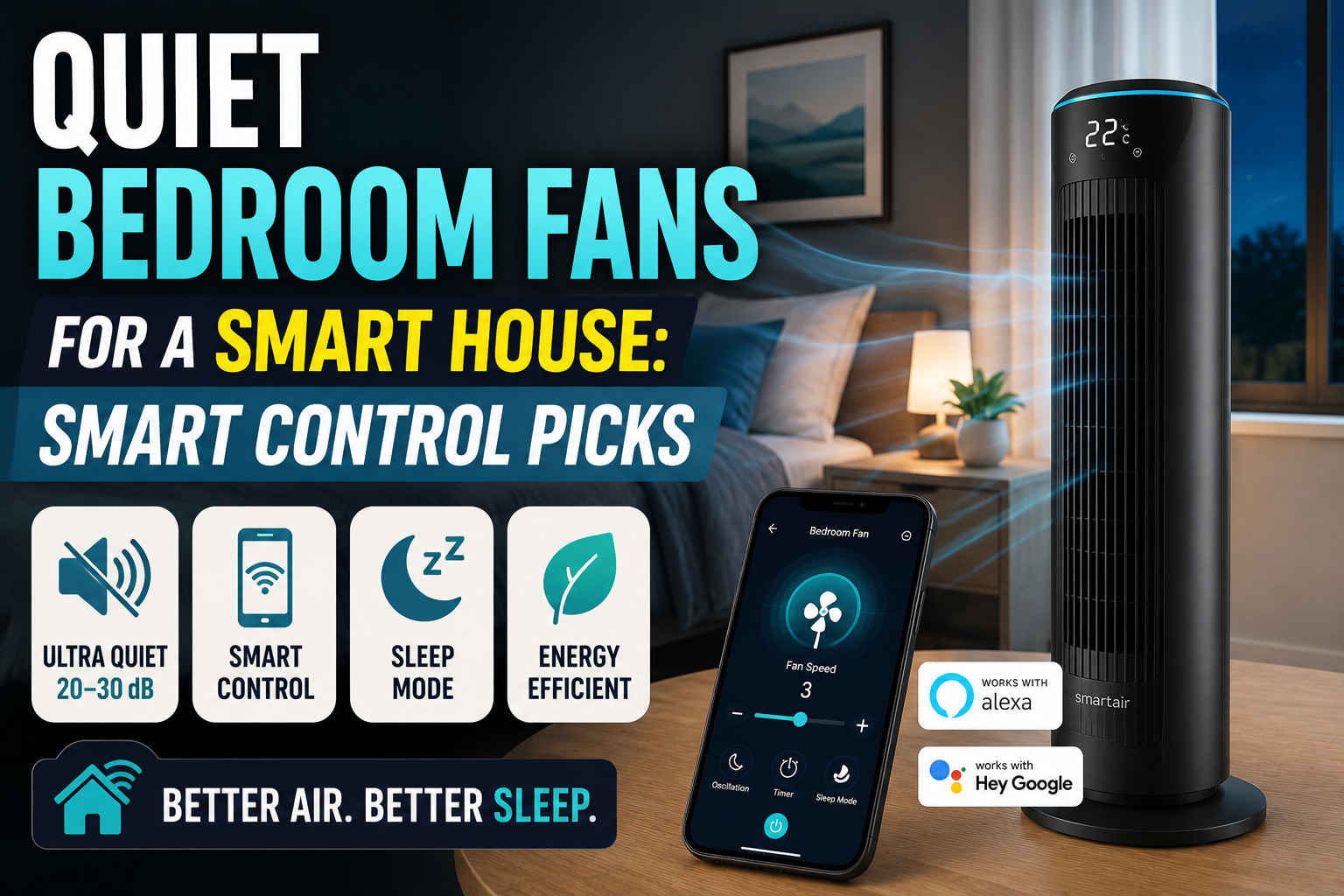
Smart Tower Fans
Tower fans are among the most popular options for bedrooms.
Their slim profile makes them ideal for apartments and smaller rooms while providing effective airflow.
Advantages
- Space-saving design
- Quiet operation
- Oscillation features
- Modern appearance
Many smart tower fans also include air purification functions, adding extra value for indoor comfort.
Smart Pedestal Fans
Pedestal fans remain a versatile choice for larger bedrooms.
Modern smart versions offer:
- Adjustable height
- Wide-angle oscillation
- Remote control
- Wi-Fi connectivity
Their larger blades can move substantial amounts of air while operating at surprisingly low noise levels.
Smart Air Circulators
Unlike traditional fans that blow air directly toward occupants, air circulators are designed to move air throughout an entire room.
Why They Work Well in Bedrooms
Air circulators:
- Promote even temperature distribution
- Reduce hot and cold spots
- Improve HVAC efficiency
- Operate quietly
They are particularly useful in smart homes where temperature consistency is a priority.
Smart Ceiling Fans
For homeowners seeking a permanent solution, smart ceiling fans provide excellent airflow with minimal noise.
Modern smart ceiling fans often include:
- DC motors
- Smart scheduling
- Voice control
- Reversible airflow modes
- Energy-efficient operation
Their elevated position allows for effective circulation without occupying floor space.
Smart Automation for Better Sleep
One of the greatest benefits of smart bedroom fans is automation.
Sleep Mode Scheduling
Many smart fans include dedicated sleep modes that gradually reduce speed throughout the night.
For example:
- High airflow during bedtime
- Medium airflow after one hour
- Low airflow during deep sleep
- Automatic shutoff before morning
This approach maximizes comfort while minimizing noise.
Temperature-Based Automation
Advanced smart homes can use temperature sensors to control fans automatically.
When bedroom temperatures rise above a predefined threshold, the fan activates.
When temperatures return to comfortable levels, the fan slows down or turns off.
This creates a hands-free climate control experience.
Geofencing Features
Some smart home ecosystems support geofencing.
As occupants approach home, the fan can begin preparing the bedroom environment automatically.
This feature is particularly useful during warm summer evenings.
Energy Efficiency Benefits
Quiet smart fans not only improve comfort but can also reduce energy consumption.
Supporting Air Conditioning Systems
A ceiling fan or tower fan can help distribute cooled air more effectively.
This often allows homeowners to raise thermostat settings slightly without sacrificing comfort.
Even a small adjustment can lead to noticeable energy savings over time.
Lower Operating Costs
Compared to air conditioning systems, fans typically consume significantly less electricity.
Running a fan overnight generally costs only a fraction of what it would cost to operate an air conditioner continuously.
For energy-conscious households, this makes smart fans an attractive addition to the home.
Real-World Example
Consider a couple living in a modern apartment.
During summer, they found that running the air conditioner throughout the night increased energy bills and occasionally made the room feel too cold.
After installing a smart tower fan with temperature-based automation, they were able to maintain comfortable airflow while reducing air conditioner usage.
The fan automatically adjusted speeds throughout the night and operated quietly enough that neither occupant noticed it while sleeping.
The result was improved comfort, lower energy costs, and better sleep quality.
Choosing the Right Fan for Your Bedroom
The best option depends on room size, budget, and personal preferences.
For Small Bedrooms
A smart tower fan is often the best balance between quiet operation and space efficiency.
For Large Bedrooms
A smart pedestal fan or ceiling fan may provide superior airflow coverage.
For Maximum Quietness
Look for fans with:
- DC motors
- Dedicated sleep modes
- Low-noise certifications
- Multiple speed levels
For Smart Home Enthusiasts
Choose models that integrate with existing smart home ecosystems and support automation routines.
Maintenance Tips for Quiet Operation
Even the quietest fan can become noisy if not properly maintained.
Clean Blades Regularly
Dust buildup can affect airflow and create unwanted noise.
Check for Loose Components
Periodic inspection helps prevent vibrations and rattling.
Update Firmware
Smart fans occasionally receive software updates that improve performance and functionality.
Position the Fan Correctly
Placing a fan on a stable surface can significantly reduce vibration-related noise.
Conclusion
Quiet bedroom fans have evolved far beyond simple cooling devices. Today’s smart fans combine silent operation, energy efficiency, intelligent automation, and seamless smart home integration to create a more comfortable sleeping environment.
Whether you choose a smart tower fan, pedestal fan, air circulator, or ceiling fan, the right model can improve airflow, enhance sleep quality, and reduce energy costs. Features such as app control, voice commands, sleep scheduling, and temperature-based automation make these devices a valuable addition to any modern smart home.
For homeowners seeking better climate control without sacrificing peace and quiet, investing in a high-quality smart bedroom fan is one of the smartest comfort upgrades available.