
One of the most practical benefits of smart home technology has nothing to do with convenience, entertainment, or even energy savings. Instead, it addresses a concern that many homeowners share whenever they leave home for an extended period: making the house appear occupied.
- Why Presence Simulation Matters
- The Evolution of Home Presence Simulation
- Smart Lighting: The Foundation of Presence Simulation
- Smart Audio as a Presence Tool
- Combining Lights and Audio for Better Results
- Geographically Adaptive Presence Simulation
- Smart Home Ecosystems and Presence Features
- Real-World Example
- Common Mistakes to Avoid
- Energy Efficiency Considerations
- Privacy and Security Benefits
- The Future of Presence Simulation
- Conclusion
Whether you’re traveling for a weekend, taking a two-week vacation, visiting family during the holidays, or simply working late, an empty home can attract unwanted attention. For decades, people relied on simple timer switches connected to lamps in an effort to create the illusion that someone was inside. While these timers offered some level of deterrence, they often followed predictable schedules that were easy to recognize.
Today’s smart homes provide a far more sophisticated solution. Through intelligent lighting automation, smart speakers, occupancy simulations, and customizable routines, homeowners can create realistic activity patterns that make an empty house appear lived in. When done correctly, presence simulation can significantly enhance home security without requiring expensive alarm systems or professional monitoring services.
In this guide, we’ll explore how smart lighting and audio devices can be used to simulate presence effectively, which automation strategies work best, common mistakes to avoid, and how modern smart home ecosystems make occupancy simulation easier than ever.
Why Presence Simulation Matters
Most residential burglaries are crimes of opportunity.
Intruders generally prefer targets that appear unoccupied because they reduce the likelihood of confrontation and increase the time available to enter and leave unnoticed.
Visible signs of occupancy can act as powerful deterrents.
These signs may include:
- Interior lighting
- Sounds coming from inside
- Activity near windows
- Television illumination
- Routine changes throughout the evening
The goal is not necessarily to create a perfect illusion but rather to introduce enough uncertainty that a potential intruder chooses an easier target.
Smart home technology excels at creating this uncertainty.
The Evolution of Home Presence Simulation
Before smart homes became common, homeowners relied on mechanical timers.
A lamp might turn on every evening at 7 PM and switch off at 11 PM.
While this was better than leaving a house completely dark, it had limitations.
The schedule rarely changed.
Every evening looked identical.
Anyone observing the property for several days could recognize the pattern.
Modern smart homes allow far more realistic behavior.
Instead of a fixed schedule, lights can vary automatically.
Different rooms can activate at different times.
Audio systems can introduce occasional sounds that suggest someone is present.
The result feels much more natural and convincing.
Smart Lighting: The Foundation of Presence Simulation
Lighting remains the most effective and widely used method of occupancy simulation.
Humans naturally associate illuminated rooms with activity.
A completely dark house often appears empty, especially after sunset.
Why Randomness Is Important
One of the biggest mistakes homeowners make is creating schedules that are too predictable.
Real people rarely behave according to identical routines every day.
For example:
A living room light might turn on at 7:15 PM one evening and 7:42 PM the next.
A bedroom light might remain active longer on weekends than weekdays.
These variations make the home appear more authentic.
Modern smart lighting systems often include randomization features specifically designed for occupancy simulation.
Creating Room-to-Room Activity
Real occupancy usually involves movement between rooms.
Instead of illuminating the entire house simultaneously, smart routines can create a sequence of activity.
For example:
- Kitchen lights activate during early evening.
- Living room lights turn on later.
- Hallway lighting appears briefly.
- Bedroom lamps activate before bedtime.
This progression closely resembles natural household behavior.
Using Different Brightness Levels
Brightness can also contribute to realism.
Not every light in a home operates at maximum intensity.
Smart dimmers allow homeowners to create more natural environments by varying brightness throughout the evening.
Subtle changes often feel more believable than fully illuminated rooms.
Smart Audio as a Presence Tool
Lighting attracts attention from outside, but sound adds another layer of realism.
Many people overlook audio when creating occupancy simulations.
Yet hearing voices, music, or everyday sounds can strongly reinforce the impression that someone is home.
Smart Speakers and Audio Systems
Modern smart speakers can play scheduled audio automatically.
Examples include:
- Music playlists
- Radio stations
- Podcasts
- Ambient household sounds
The objective is not volume but realism.
A television-like soundtrack heard faintly through a window may be enough to suggest occupancy.
Simulating Everyday Life
Real homes generate a variety of sounds.
Occasional audio events can mimic:
- Television viewing
- Music listening
- Kitchen activity
- Conversations from media content
When combined with lighting changes, these sounds create a far more convincing illusion.
Avoiding Obvious Automation
Audio should be used carefully.
Repeating the same music playlist at identical times every day may become predictable.
Variety is important.
Many smart home systems allow randomized playback schedules that feel more authentic.
Combining Lights and Audio for Better Results
The most effective presence simulations use multiple indicators simultaneously.
A single lamp turning on may attract little attention.
However, when lighting changes are accompanied by occasional audio activity, the impression becomes much stronger.
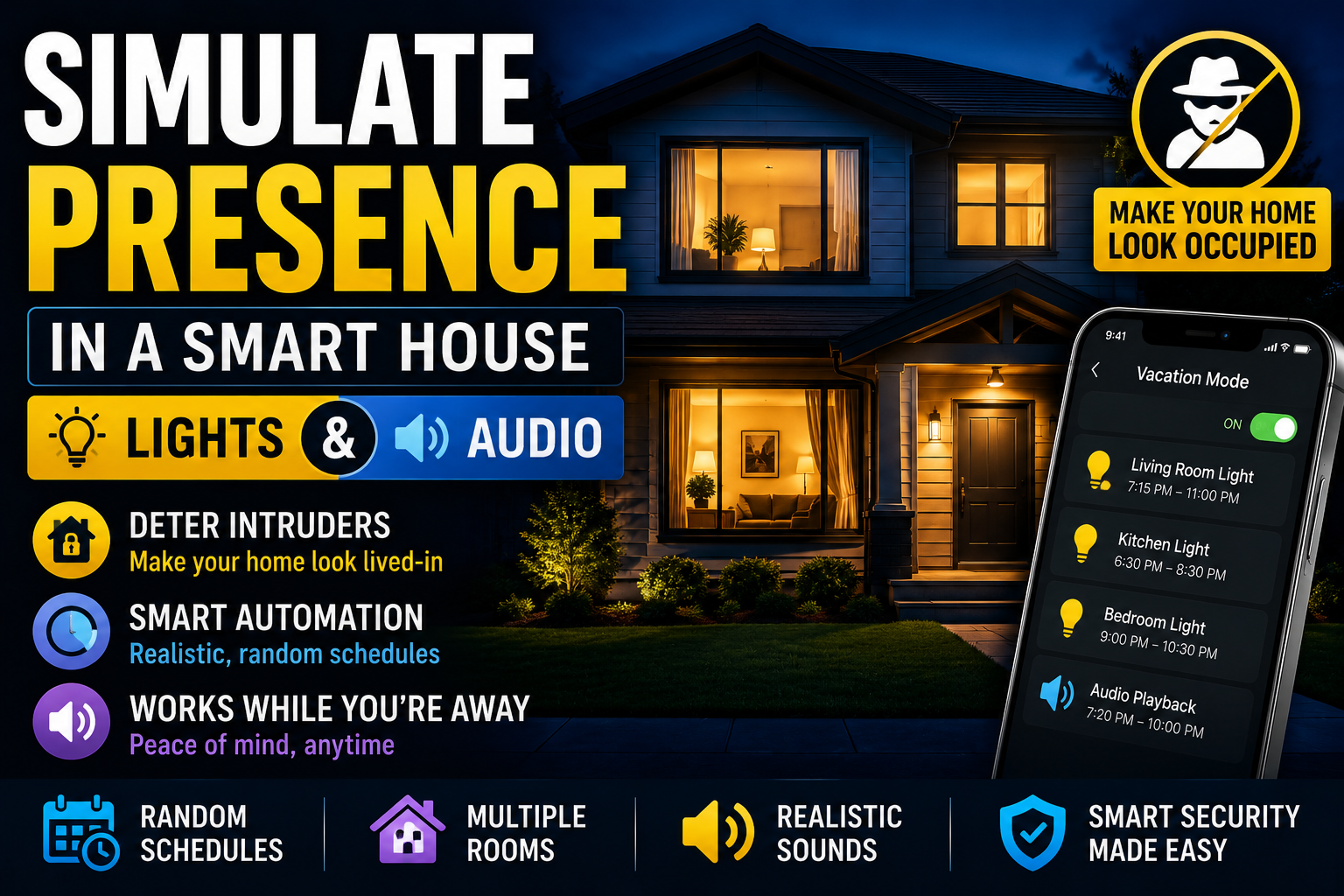
Example Evening Routine
Imagine a homeowner traveling for a week.
A smart home routine might create the following sequence:
6:30 PM:
Kitchen lights activate.
7:15 PM:
Living room lights turn on.
7:20 PM:
A smart speaker begins playing low-volume radio content.
8:45 PM:
Kitchen lights turn off.
9:00 PM:
Bedroom lamp activates.
10:30 PM:
Audio playback stops.
11:00 PM:
Remaining lights gradually switch off.
This pattern resembles ordinary household activity far more than a simple timer.
Geographically Adaptive Presence Simulation
Some advanced systems incorporate location awareness and sunset-based automation.
Instead of relying on fixed schedules, routines adjust automatically according to seasonal daylight changes.
Why This Matters
Sunset occurs at different times throughout the year.
A lighting schedule that appears natural during winter may look unusual during summer.
Adaptive automation helps maintain realism.
The home behaves in a way that matches actual environmental conditions.
Smart Home Ecosystems and Presence Features
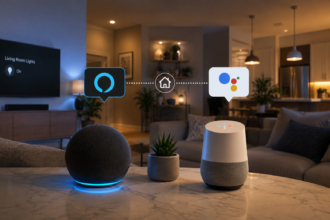
Many smart home platforms now include dedicated occupancy simulation modes.
These systems can automatically create realistic activity patterns based on historical usage data.
Learning From Daily Behavior
Some platforms analyze normal household routines.
They observe:
- Typical lighting usage
- Preferred rooms
- Evening habits
- Weekend patterns
When activated, vacation mode reproduces these behaviors automatically.
This often creates more realistic simulations than manually programmed schedules.
Integration With Security Systems
Presence simulation becomes even more powerful when integrated with broader security systems.
For example:
- Motion detection can trigger exterior lighting.
- Doorbell activity can activate indoor lights.
- Security alerts can temporarily alter lighting patterns.
These interactions create a more dynamic and responsive environment.
Real-World Example
Consider a family that travels every summer for two weeks.
Previously, they relied on a single timer controlling one lamp in the living room.
Every evening, the light switched on at exactly 7 PM and off at exactly 11 PM.
While away, a neighbor commented that the pattern was noticeably repetitive.
The following year, the family upgraded to a smart home system.
The new setup included:
- Smart bulbs in multiple rooms
- Automated brightness adjustments
- Randomized schedules
- Smart speaker routines
The home now appeared active in different areas throughout the evening.
Lighting varied naturally, and occasional audio playback suggested occupancy.
The result was far more convincing and required no manual intervention.
Common Mistakes to Avoid
Leaving Every Light On
Many people assume that more lighting equals better security.
In reality, fully illuminated homes often appear unnatural.
Most occupied homes use only selected rooms at any given time.
Repeating Identical Schedules
Predictability reduces effectiveness.
Randomization is one of the most important aspects of successful presence simulation.
Ignoring Outdoor Visibility
Not all lights contribute equally.
Prioritize rooms visible from the street or neighboring properties.
These are the areas most likely to influence perceptions of occupancy.
Using Excessive Audio Volume
The purpose of audio is subtle reinforcement.
Overly loud playback can seem unusual and may even attract unwanted attention.
Energy Efficiency Considerations
Some homeowners worry that occupancy simulation increases energy consumption.
Fortunately, modern LED lighting consumes very little electricity.
A few strategically placed LED bulbs operating for several hours each evening typically use far less energy than many household appliances.
Smart automation can also optimize efficiency by ensuring lights operate only when needed.
Balancing Security and Consumption
The objective is not to illuminate the entire house continuously.
Thoughtful routines can maintain realism while minimizing energy use.
In many cases, smart occupancy simulations consume surprisingly little power.
Privacy and Security Benefits
Unlike cameras, occupancy simulation does not require collecting sensitive video footage.
This makes it an attractive security enhancement for privacy-conscious homeowners.
The system works by creating the appearance of activity rather than monitoring occupants directly.
For many households, this balance between security and privacy is highly appealing.
The Future of Presence Simulation
Artificial intelligence is beginning to transform smart home automation.
Future presence simulation systems may become even more realistic through:
- AI-generated activity patterns
- Predictive behavioral modeling
- Dynamic audio generation
- Adaptive lighting based on neighborhood conditions
- Integration with broader security ecosystems
Rather than following predefined rules, future systems may continuously adjust behavior based on real-world context.
This could make occupancy simulation nearly indistinguishable from actual human activity.
Conclusion
Simulating presence in a smart house is one of the most practical and effective uses of modern home automation. Through intelligent lighting schedules, carefully planned audio routines, and adaptive automation, homeowners can create realistic signs of occupancy that enhance security while maintaining convenience.
Unlike traditional timer-based solutions, modern smart homes can vary behavior naturally, replicate everyday household activity, and adapt to changing conditions throughout the year. By combining lights and audio thoughtfully, homeowners can reduce the appearance of vacancy and create an environment that feels genuinely lived in—even when nobody is home.
As smart home technology continues to evolve, presence simulation will become increasingly sophisticated, offering homeowners an accessible and effective way to strengthen security without sacrificing comfort, privacy, or energy efficiency.