
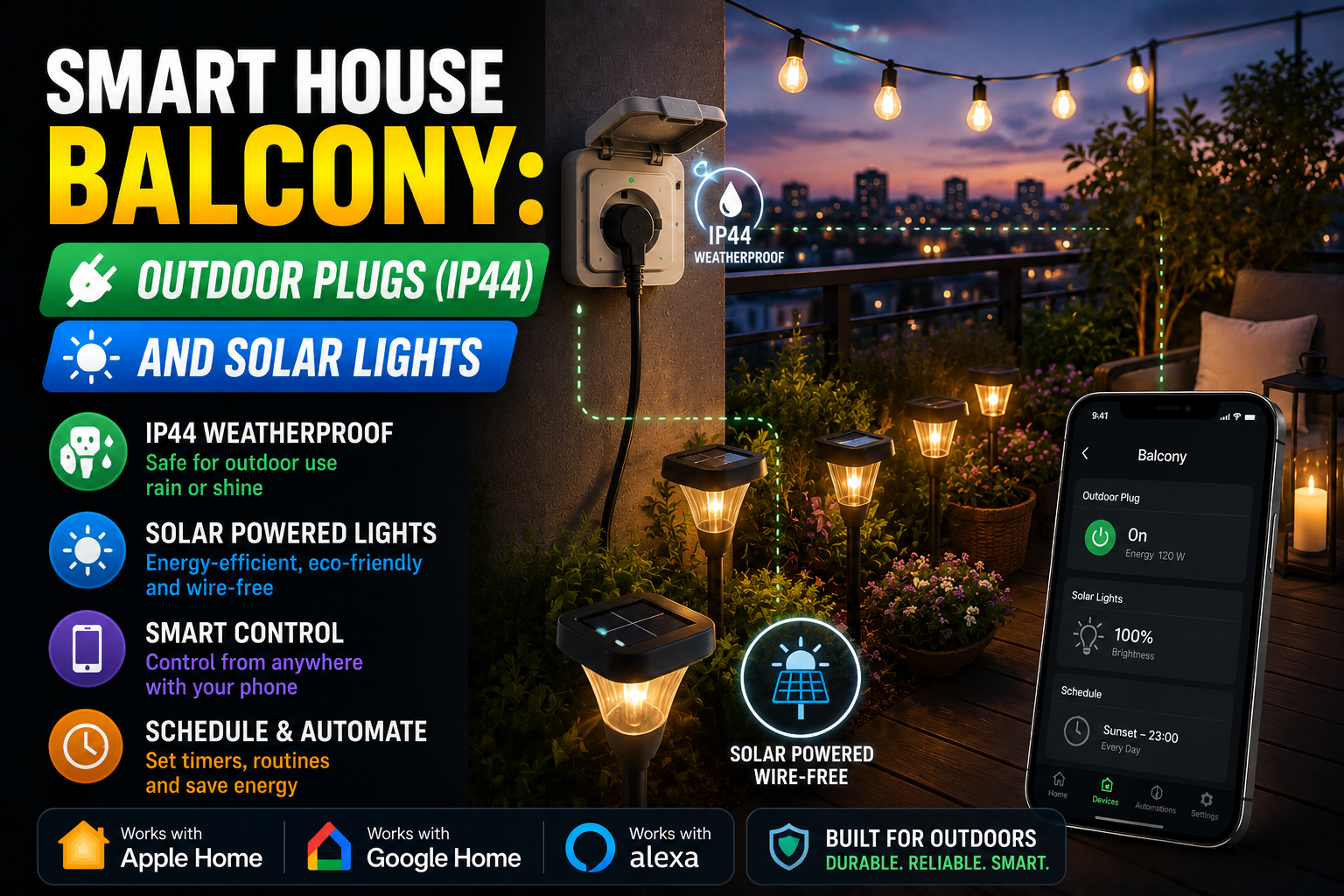
Turning your outdoor space into a connected extension of your home — without running new cables or calling an electrician
- Understanding the Outdoor Environment: Why IP Ratings Matter
- Smart Outdoor Plugs: The Foundation of a Connected Balcony
- Solar Lights: More Capable Than You Probably Expect
- Combining Both Systems: A Cohesive Balcony Automation
- Installation, Safety, and Maintenance Notes
- Conclusion: The Balcony Deserves Better Than an Afterthought
Most smart home projects start indoors. The thermostat, the lights, the security camera by the front door — these are the obvious entry points, and they get most of the attention. But there’s a square footage problem lurking in many homes that nobody talks about enough: balconies and terraces are used almost like afterthoughts, decorated once and then largely ignored from a technology standpoint.
That’s a shame, because a well-equipped balcony isn’t just a nicer place to have a morning coffee. It’s an extension of your living space, a spot for evening gatherings, a place where plants grow and string lights glow and the boundary between indoors and outdoors softens in the best possible way. Making it smart — genuinely smart, not just “I bought some solar lanterns from a discount bin” smart — involves two technologies that complement each other more naturally than most people realize: outdoor-rated smart plugs with IP44 protection ratings, and solar-powered lighting systems that have grown remarkably sophisticated in recent years.
Neither of these requires a building permit or a licensed electrician. Both are accessible to anyone willing to spend an afternoon and think carefully about what they actually want from their outdoor space.
Understanding the Outdoor Environment: Why IP Ratings Matter
Before diving into products and setups, it’s worth spending a moment on something that gets glossed over in a lot of smart home content: the difference between an indoor device and one that can genuinely survive outdoors.
IP ratings — Ingress Protection ratings — are defined by international standard IEC 60529 and describe how well a device resists solid particles and liquids. The rating consists of two digits. The first covers dust and solid particle protection on a scale from 0 to 6. The second covers water protection on a scale from 0 to 9. IP44, which is the minimum you should accept for a balcony installation, means the device is protected against solid objects larger than 1mm and against water splashing from any direction.
That last part is important. A balcony isn’t a swimming pool, but it’s also not a living room. Rain blows in from the side. Condensation forms on cold mornings. If you’re watering plants nearby, water will splash. A device rated IP44 handles all of that without issue. What it won’t handle is being submerged or hit by a high-pressure hose — for those conditions you’d want IP65 or higher — but for a typical covered or semi-covered balcony, IP44 is the practical sweet spot between protection and cost.
Anything less than IP44 in an outdoor environment is a gamble. You might get lucky for a season, but you’re looking at corrosion, circuit failures, and in worst cases, real safety hazards. This isn’t a place to cut corners.
Smart Outdoor Plugs: The Foundation of a Connected Balcony
A smart outdoor plug does something deceptively simple: it gives your home automation system control over anything plugged into it. String lights, a portable speaker, a small heater, a water feature pump, an outdoor fan — anything with a standard plug can become remotely controllable, schedulable, and in some cases energy-monitored.
What to Look For Beyond the IP Rating
The IP44 rating is table stakes. Beyond that, a few features separate a good outdoor smart plug from a frustrating one.
Protocol matters. Wi-Fi plugs are the most common and easiest to get started with — no separate hub required, they connect directly to your router, and most work with Alexa, Google Home, and Apple HomeKit. The trade-off is that they depend on your router’s range, and a thick concrete balcony wall can create dead zones. If your Wi-Fi signal is weak on the balcony, you’ll have a smart plug that intermittently goes offline, which defeats the purpose.
Zigbee and Z-Wave plugs require a hub but generally handle range issues better through mesh networking — each device acts as a repeater, strengthening the signal across the network. If you’re already running Home Assistant or SmartThings, adding Zigbee outdoor plugs is often the more reliable long-term choice.
Dual outlets are worth seeking out. Several outdoor smart plugs, like the TP-Link Kasa EP40A or the Teckin SP22, offer two independently controlled outlets in a single unit. This is genuinely useful on a balcony: outlet one controls the string lights on a sunset schedule, outlet two controls the water pump on a different timer entirely. One device, two distinct automations.
Energy monitoring adds real value outdoors. This feature is more appreciated outside than inside, oddly enough, because outdoor devices like patio heaters and decorative water features are things people tend to forget about. An outdoor plug with energy monitoring will show you — sometimes alarmingly — exactly how much that electric heater is costing you when left on overnight.
Practical Setups That Actually Work
Consider a simple but effective configuration: a weatherproof outdoor smart plug installed near the balcony door, connected to a string of outdoor Edison bulbs draped along the railing. An automation in Home Assistant (or even just a native schedule in the Kasa app) turns the lights on thirty minutes before sunset and off at 11pm. No switches, no manual effort. The balcony is always lit when you want it lit, and never running electricity through the night when you’ve gone to bed.
A more sophisticated version adds an outdoor motion sensor. Lights come on at sunset, but if no motion is detected after midnight, they shut off automatically. If someone steps onto the balcony at 2am, they turn on briefly. This layered logic — time-based plus presence-based — is what separates a genuinely smart setup from one that’s just automated.
One real-world example worth considering: a small apartment balcony in Barcelona where the owner runs a Wi-Fi outdoor plug connected to a drip irrigation controller for potted plants. The plug is scheduled to run for twenty minutes every morning before the heat of the day. The whole setup cost under sixty euros and has kept a collection of tomatoes and herbs alive through two summers without daily manual watering.
Solar Lights: More Capable Than You Probably Expect
Solar lighting has had a reputation problem. The early generation of solar garden lights — small plastic stakes with dim LEDs that barely lasted through the night — set expectations embarrassingly low. The technology has moved on considerably, and if you haven’t looked at solar lighting in the last three or four years, you might be surprised.
How Modern Solar Lighting Systems Work
Quality solar lights today use monocrystalline silicon panels, which are significantly more efficient than the polycrystalline panels used in cheaper units, especially in diffuse or indirect light conditions — important for balconies that may not receive direct sun all day. They pair these with lithium iron phosphate (LiFePO4) batteries, which hold charge better over more charge cycles and perform more reliably in cold temperatures than the older lithium-ion configurations.
The result is a light that can charge adequately from a few hours of partial sun and run for eight to twelve hours through the night. Some high-end units include a light sensor that adjusts brightness based on remaining battery level — running at full brightness in the early evening and dimming to a lower setting as the night progresses, prioritizing staying on over maximum output.
Smart Solar Lights: When Connectivity Meets Sustainability
The genuinely interesting development is smart solar lights — units that connect to your home network (almost always via Wi-Fi) and integrate with platforms like Alexa, Google Home, or Apple HomeKit. The Govee Outdoor Solar Lights and the Litom Solar Spotlights are among the more established options here, though the market is expanding quickly.
What smart connectivity adds to a solar light is meaningful control. You can set schedules that differ from the default “on at dusk, off at dawn.” You can dim them to 30% for atmospheric evening light and ramp up to full brightness if motion is detected. You can change color temperature — warmer for relaxed evenings, cooler for functional task lighting. And you can group them with other smart devices, so that when you say “good night” to your smart home system, the balcony lights included in that routine switch off along with everything else.
Placement Strategy: Getting the Most From Solar on a Balcony
Balcony solar installations require more thought than garden installations because you’re often working with constrained sunlight exposure. A few principles that make a significant difference:
The solar panel doesn’t have to be attached to the light fixture. Many quality solar light systems — particularly solar spotlights and garden stake lights — separate the panel from the light unit with a cable, sometimes up to three meters long. This means you can position the panel where it gets maximum sun exposure (mounted on the top railing or an outward-facing wall) while placing the actual light wherever it’s aesthetically useful.
South-facing balconies in the northern hemisphere (north-facing in the southern hemisphere) get the most direct sun and will charge panels most efficiently. East and west-facing balconies work well if the panel can be oriented to capture morning or afternoon sun respectively. North-facing balconies present the most challenge, but a panel mounted vertically on the outer railing at the correct angle can still capture adequate diffuse light for modest lighting applications.
Avoid placing panels where they’ll be shaded by the balcony above, overhanging plants, or awnings during peak sun hours. Even partial shading during the key charging window significantly reduces overall battery fill by end of day.
Combining Both Systems: A Cohesive Balcony Automation
Where things get genuinely satisfying is when outdoor plugs and solar lights work together as part of a unified outdoor scene.
Picture this: as the sun sets, an outdoor lux sensor (or simply the built-in scheduling of your home hub) triggers a “balcony evening” scene. The smart outdoor plug switches on the string lights connected to it. The solar spotlights, which have been charging all day, automatically activate via their dusk sensor. The irrigation plug runs its last cycle of the day. The result is a balcony that’s warm, lit, watered, and ready — all without a single manual switch being touched.
Voice control adds another layer. “Hey Google, balcony on” activates the outdoor plug (and by extension, any lights or devices plugged into it) while simultaneously triggering the smart solar lights if they’re connected to the same ecosystem. When guests are over, you’re not running around toggling individual devices.
For those using Home Assistant specifically, the outdoor environment opens up interesting automations tied to weather data. If the forecast shows rain after 9pm, the system can preemptively turn off the outdoor plug powering decorative lights, preventing the cycling of weatherproof but not fully waterproof decorative elements. It can also skip the morning irrigation if significant rainfall is detected overnight.
Installation, Safety, and Maintenance Notes
Outdoor smart plugs need to be installed in locations where the plug itself won’t sit in standing water. Most IP44-rated units include covers that protect the socket when nothing is plugged in, but under sustained rain in an exposed position, even IP44 protection has practical limits. A semi-covered area, or a position sheltered by the balcony above, is always preferable.
Extension leads used outdoors must also be rated for outdoor use. This sounds obvious but is frequently overlooked — indoor extension cables have no moisture protection and represent a genuine hazard when used outside, regardless of what’s at the end of them.
Solar lights require essentially no maintenance beyond the occasional cleaning of the panel surface. Dust, bird droppings, and mineral deposits from rain reduce charging efficiency noticeably. A wipe with a damp cloth every month or two is enough to keep panels performing at their best.
Battery replacement in solar lights typically becomes necessary after three to five years, depending on the quality of the original battery and how deeply it’s cycled each night. Most manufacturers make replacement batteries available, and swapping them is usually a simple task that extends the useful life of an otherwise functional fixture significantly.
Conclusion: The Balcony Deserves Better Than an Afterthought
A smart balcony doesn’t require rewiring your building or spending thousands of euros. The combination of IP44-rated smart outdoor plugs and modern solar lighting systems — especially when those systems include smart connectivity — gives you a genuinely capable outdoor space that responds to schedules, presence, voice commands, and weather conditions with minimal effort once set up.
The technology is accessible, the installation is non-destructive, and the payoff is immediate. An outdoor space that lights itself at the right time, that you can control from your phone when you’re already inside with a glass of wine, that waters your plants without you remembering to — that’s not a luxury. That’s just a thoughtfully designed home that happens to extend past the sliding door.
Start with a quality IP44 outdoor plug and one reliable solar spotlight. Build from there. The balcony you’ve been meaning to properly set up for the last two years is closer than you think.